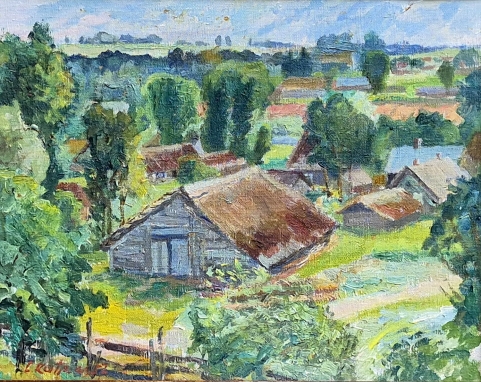
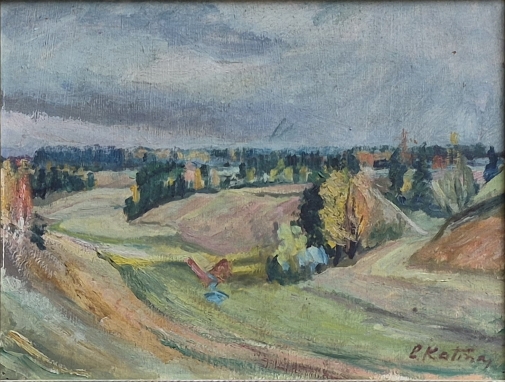
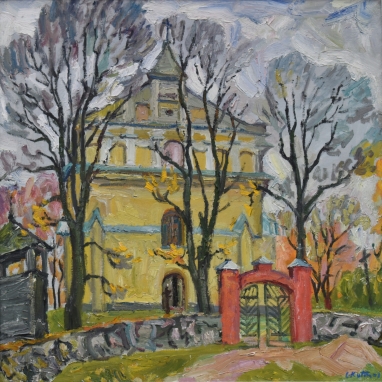
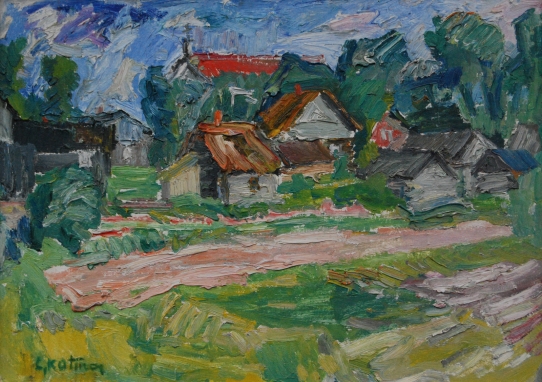
Voruta, 1952, cardboard, oil, 26.5x34.5 cm, frame 35.5x43.5 cm
The painting belongs to the early period of the artist's creative work, when the influence of Lithuanian modernism and the post-impressionist landscape tradition is still clearly felt in his painting. At this time, the artist had graduated from the Vilnius Institute of Art and was actively forming a unique pictorial language, in which academic drawing is combined with a freer color and emotional perception of the landscape.
The composition opens up a panorama of undulating fields and forest belts. The landscape is conveyed not with topographic accuracy, but as an emotional image of the Lithuanian land. Gently modeled hills, winding roads and trees illuminated by autumn colors create a mood of peace and historical memory. The canvas is dominated by muted greenish, brownish and bluish tones, which are enlivened by flashes of light and expressive strokes.
The name “Voruta” is inevitably associated with the legendary castle of the Lithuanian king Mindaugas – one of the most important symbols of Lithuanian statehood. Although there is no direct architectural motif in the painting, the landscape itself can be perceived as a poetic vision of historical Lithuania, in which nature becomes a sign of national memory and cultural continuity. Such a symbolic interpretation of the landscape was characteristic of Lithuanian art of the mid-20th century.
Katinas is considered one of the significant Lithuanian painters, who in his work went from traditional landscape and realistic painting to later expressive and abstracted forms. Early landscapes, including “Voruta”, are appreciated for their sensitive coloring, lively painterly strokes and the ability to see not only the visible reality, but also its cultural meaning in Lithuanian nature.