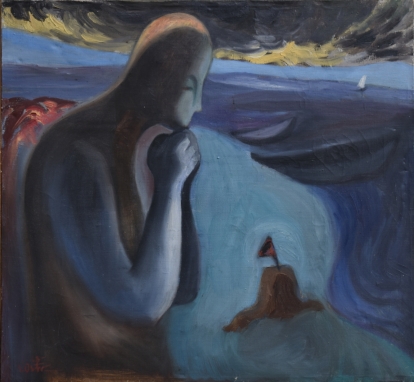
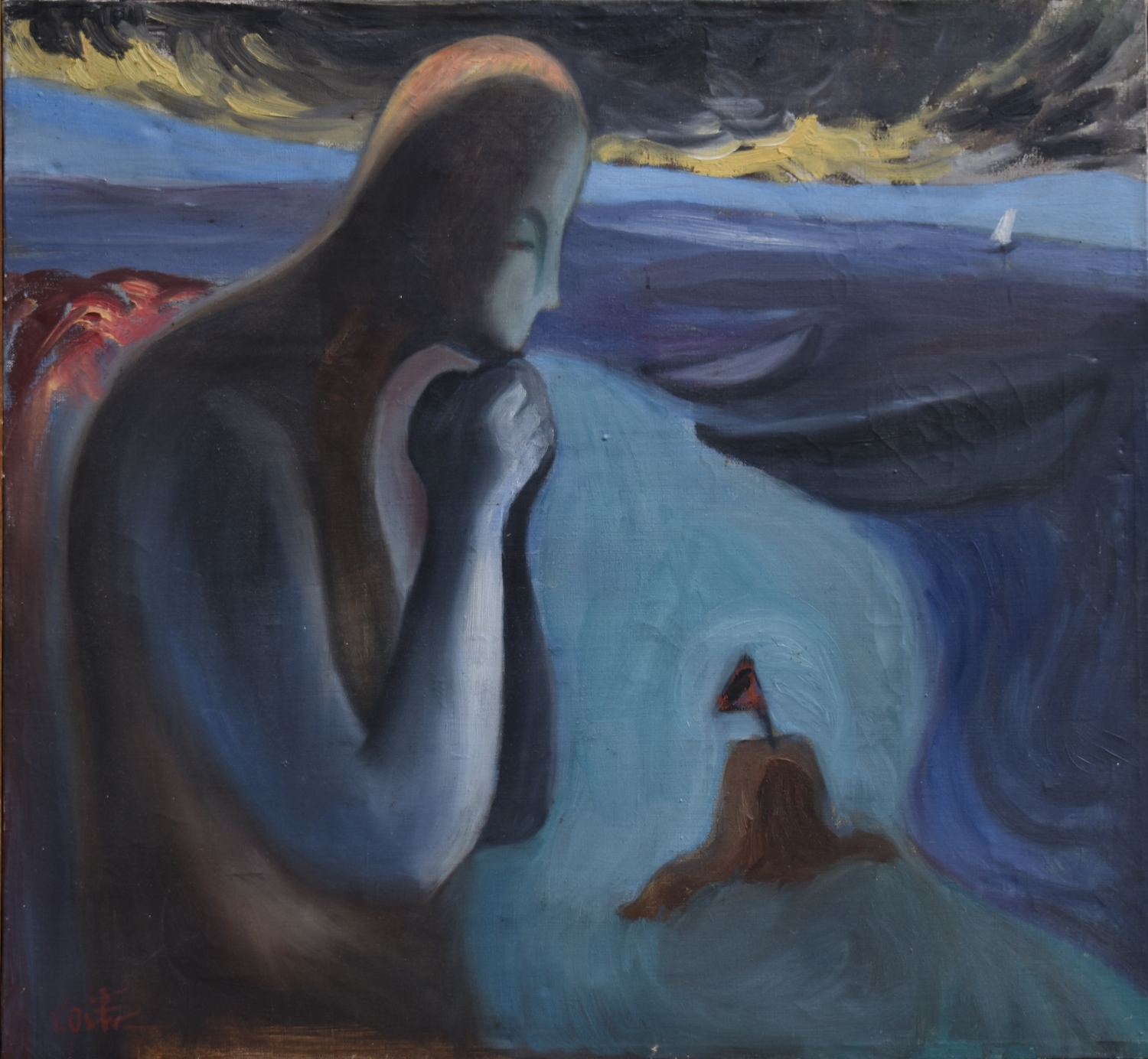
Farewell, 1968, canvas, oil, 55x59 cm

In 1951, he graduated from the Kaunas State Institute of Applied and Decorative Arts with a degree in decorative and monumental painting (stained glass).
He worked in pedagogy and later only in creative work. She has been active in the field of pure painting, creating many valuable interior and exterior works.
Participated in exhibitions since 1956.
The works are in the Mo Museum and other Lithuanian art museums and private collections.
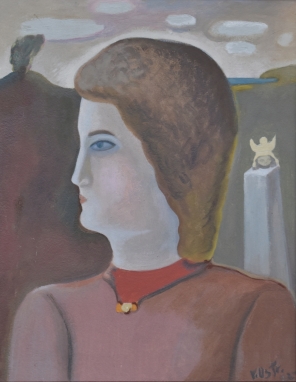
In some compositions the female figure is monumental, in others it is more generalized or decorative, stylized. Sometimes a woman does not have facial features or they are only vaguely marked and she is more like a creature, shadow or emotion. Emotion is expressed through a woman's movement, pose, silhouette, gesture - she lowers her head and / or eyes, raises her hands, as if silently calling for help or mourning, or vice versa - sitting restrained with her hand on her hand. Often a woman is puzzled, drowning in her thoughts or sadness; this impression is reinforced by the predominant cold color. Her face, sometimes the whole figure in shades of blue, green, gray. Tones of cool colors are characteristic of all Ostrauskiene's paintings, and the warm local colors that contrast with them reinforce the expressed emotion. So her sadness is restrained. Silhouette of wavy sleek lines; although there is a sad mood, the figure is not drastically deformed.
The sadness on a woman’s face even radiates in the spring, even though she dances with a flower in her hand. This is perhaps a kind of replica of the official art that prevailed at that time - spring is usually depicted as a holiday, life as a holiday, work as a holiday, and so on. t. There are many such remarks and implications on the artist's canvases. So it is not surprising that the works of the artist for exhibitions seemed too sad to the then Minister of Culture Jonas Bielinis and most of them were rejected. And art critics associate the sadness prevailing in Valeria's work with the post-war tragedy.
The artist in 1945. October 11 wrote in a diary: “In Raguva [...] there were nine men lying on the path. Young as strong as oaks. Someone showed them their bunker ... Kicked them with their feet. The insane rejoiced. Good God, how long will this continue? I will be Violet and I will donate half my heart for them ... ”
The paintings are dominated by visions intertwined with memories, painful experiences. Water is also a common element in the works. It is a sea, a meandering river, sometimes a very ornamental lake in an almost regular oval shape, with an island or a floating swan. The horizon is flooded with a mountain or mountain silhouette.
The artist also had to paint commissioned works. From a blog post we learn about her anxiety, dissatisfaction, and internal turmoil: “In Moscow, at the Baltic Exhibition, my commissioned work Feast (1973) is hanging. He does me no honor, but I have worked for a long time; [...] As the sword of Damocles hung over me: "works are realistic", "art belongs to the people" ... ] I am not so healthy and strong that as Jura [theater director - R. D.] I can go to break stones. God help me! ”
A common motif of a mother with a child in Ostrauskiene's work. The artist interprets this motif in very different ways - in some canvases she is clearly approaching Christian iconography, in others she is talking about everyday experiences: worry, anxiety, care, the pain of saying goodbye. The stylistics of these paintings are also very different: some are dominated by a realistic manner of painting, others by a generalized drawing, local color spots, sleek rhythmically wavy lines, more or less deformed figures. A woman with a child is depicted against the backdrop of nature, a panorama of the city, the countryside, or visions where fantasy merges with reality.
The artist has created portraits, landscapes, compositions with characters from literary works - mostly female heroines. Her work also features experimental canvases reminiscent of the artistic expression of the surrealists of Marco Chagall, Ernst Ludwig Kirchner."
Rasa Dargužaitė