
XXX, 91, canvas, oil, 60x80 cm

kategorijos
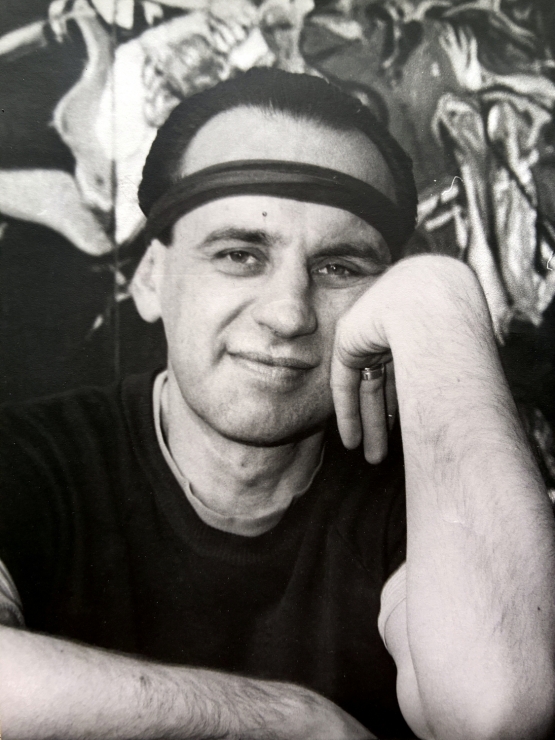
Vytautas Eigirdas 1957-2012
BULLYING. Between Color and Form
This phrase could become the motto of Vytautas Eigirdas's work. It could, if the painter, apart from the formal aspects of composition, did not care about the content of the paintings. The artist pays a lot of attention to portraits and still lifes, but the majority of his works consist of biblical-mythological compositions. V. Eigirdas declares a non-stereotypical treatment of the Holy Scriptures, a radical manner enriched with plastic, equivalent compositional elements. And the symbolic interpretation of the text opens the door to the knowledge of the individual world.
In order to express his idea more convincingly, V. Eigirdas deforms the modeled world, challenges the traditional canons of art. If in the Lithuanian context we perceive tradition as a manifestation of expressionist tendencies in various styles, then it would be easier to assess the relationship of V. Eigirdas' painting with them, the impact of the aforementioned tendencies and the need to use them in creation.
V. Eigirdas begins this semi-abstraction with peculiar studies of landscape structure. In the works of the 1980s, there is an obvious desire to free color and form from the standard "packaging" - a meager color scheme, an earthy color palette, and monotonous stylization. V. Eigirdas bases his search for an individual style on a scheme that leaves no room for gesture painting, rough and dry pastoticity, so highly valued by expressionists. In practically engaged art, he discovers the basis of future works of his mature period - a strict local arrangement of color spots; glazes, rational use of paint texture and canvas texture, and most importantly, he connects this with painting technique. Painting on colored ground, applying paint with a roller, alternating relief and smooth, shiny and matte areas - these are just a few of the means of his wide range of expression. By logically manipulating them, avoiding careless spontaneity, an ideologically unfounded ethos, the unity of color and decorative plane is discovered. Thus, the content is equated with the form.
Since the beginning of the 1990s, we can already talk about a purposefully created myth and an adequate expression chosen for it.
Mythology. V. Eigirdas, perhaps the only painter in Lithuania, gave a sharp expression to the religious theses of Christianity. Rejecting the common, banal, reportage retelling of biblical themes, he interprets fragments of Old Testament prophecies, sentences that evoke associations. In other words, he creates a pictorial myth based on an unconventional approach to canonical things. Therefore, it is not surprising that the images are full of creepy, mystical scenes, surrealistic constructions connecting people and demons, and symbols. Despite the painterly changes, the relationship between "good and evil", "light and darkness" in the paintings remains constant until the most recent works. Seductive, lustful poses of naked women, real vessels of sin, characters splashing with fire and sword, horned, bloody beings of a unified spirit - everything boils in one cauldron of creation. The prophecies of Ezekiel, the revelation of the Gospel of St. John and other rich multifaceted themes become a constant, inexhaustible source of creativity. Let us not forget that biblical texts, studded with metaphors and allegories, are complex in themselves. They speak a different dialect to everyone. Therefore, the artist does not bother with deciphering, he simply reveals the perceived information through color and form.
Mythology. V. Eigirdas, perhaps the only painter in Lithuania, gave a sharp expression to the religious theses of Christianity. Rejecting the common, banal, reportage retelling of biblical themes, he interprets fragments of Old Testament prophecies, sentences that evoke associations. In other words, he creates a pictorial myth based on an unconventional approach to canonical things. Therefore, it is not surprising that the images are full of creepy, mystical scenes, surrealistic constructions connecting people and demons, and symbols. Despite the painterly changes, the relationship between "good and evil", "light and darkness" in the paintings remains constant until the most recent works. Seductive, lustful poses of naked women, real vessels of sin, characters splashing with fire and sword, horned, bloody beings of a unified spirit - everything boils in one cauldron of creation. The prophecies of Ezekiel, the revelation of the Gospel of St. John and other rich multifaceted themes become a constant, inexhaustible source of creativity. Let us not forget that biblical texts, studded with metaphors and allegories, are complex in themselves. They speak a different dialect to everyone. Therefore, the artist does not bother with deciphering, he simply reveals the perceived information through color and form.
Art critic Ignas Kazakevičius


