
Arvydas Baltrunas, Eternal Plots: Love, Temptations, Death ..., 10 March- 30 April 2022


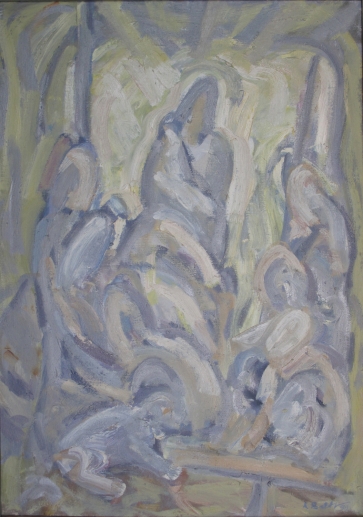
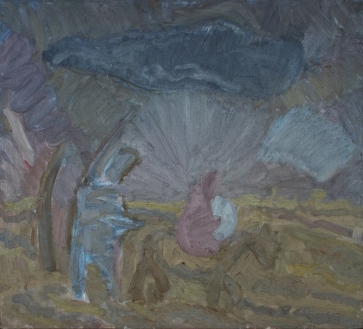
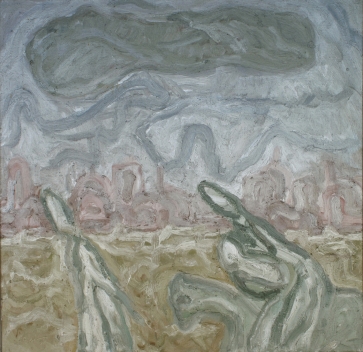

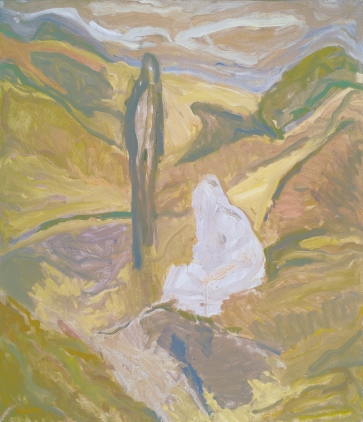

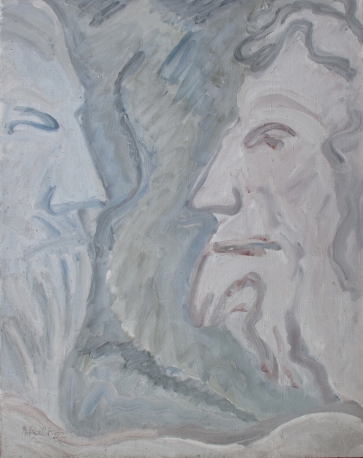


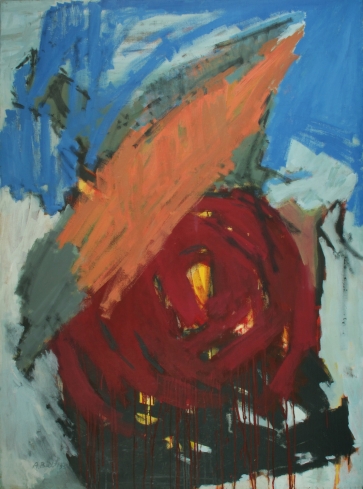
The creative works of painter Arvydas Baltrūnas reflect spiritual view, and his painting language is dynamic and filled with contrasts. The lyrical images of reality are either combined with mythological (biblical) compositions or filled with philosophical meanings and narratives. The colors in his paintings range from sublime bright tones to achromatic silver ones or even sharp, dramatic color combinations.
To describe Baltrūnas’s work, the words of Vasilij Kandinsky (1866–1944), an innovator of modern art, might be apt: “It is important to discover (reanalyse) the ambivalence of wisdom and heart while creating art.” For Baltrūnas, the search for this harmonic ambivalence is marked by contradictions: from gentle spiritual compositions to complex explosions of energy.
Arvydas Baltrūnas was born in 1957 in Vilnius. From 1975 to 1981, he studied applied science at Vilnius University and was enrolled in the Vilnius art school program. From 1981, he took a direction towards fine arts and was admitted to the Vilnius Art Institute (now the Vilnius Academy of Arts), from which he graduated in 1987. Since 1988 he has worked at the Vilnius Students House. From 1997 to 2015, he worked as a teacher at Vilnius Art School for Children and Youth and since 2000 at the National M. K. Čiurlionis School of Art. Since 1992, he has been a member of the Lithuanian Artists’ Association. In 1994 he established the art group “Ė.” He received the highest accredited national scholarship in both 2001 and 2008. Baltrūnas has organized 33 solo shows and participated in near 100 group exhibitions and plein air sessions in Lithuania and abroad. His professors of painting were Vladas Karatajus (1925–2014), Augustinas Savickas (1919–2012), Jonas Čeponis (1926–2003), and Kostas Dereškevičius. His inspirations include Antanas Gudaitis’s (1904–1989) and Jonas Švažas’s (1925-1976) works as well as Arvydas Šaltenis and Ričardas Vaitiekūnas, French modernists Henri Matisse (1869-1954) and Georges Rouault (1871-1957), and the Spanish classical artist El Greco (1541-1614).
His early works of the 1990s are focused on reality and modernism, and his art from the end of that decade reflects a variety of stylistic expressions. He painted works of a poetic aesthetic, visualizing daily sceneries within interiors and figures moving fragilely within the scenes. After Lithuania gained independence, Baltrunas became began to participate in exhibitions and actions. While continuing his work with painting, he was engaged in the avant-garde art communities and collaborated with young, creative, critical like-minded individuals, including composers, writers, and artists. Later, his painting language embodied biblical scenes that carried universal themes; it visualized the dramatic value unfolding in the lives of the saints.
With his discovery of a new painting language in 2010, he created a series of silver still-lifes incorporating figurative nuances. In the cycle of 14 pictures, The History of Pain (1995–1996), he expresses the conditions of tragedy via painting, not by using recognizable objects, but instead by applying contrasting, multilayered strokes of black, white, red, orange, blue, and yellow. With the light of impressionism, he marks the cycle of Vilnius cityscapes in A Look at St. Bartholomew (2005–2012). Since 2009 he has been practicing tango, which moved him create the series The Feeling of Tango (2009). For Baltrunas, the years 2011–2021 were focused on rethinking; he started to work with painting as a medium for synthesizing and abstracting reality. He is discovering the points of connection between a plastic reality and spirituality. He uncovers the characteristics of different genres, especially landscape and still-life. The artist states: "I don’t research. I paint." He is focused on experimenting and creating, not stories, but directions for the viewer’s perception and thoughts. In parallel, he enjoys painting as a process—the colors and traces of the brush.
Art critic Nijolė Nevčesauskienė


